Creating a simple recipe template isn’t about adding complexity—it’s about establishing clarity. Drawing from how chefs and kitchen managers document recipes for training and daily production, a beginner-friendly template focuses on essentials only: ingredient order, clear instructions, and basic timing. Everything else is optional.
This guide walks you through how to create a simple recipe template for beginners, using proven kitchen structure adapted for home use. By the end, you’ll have a reusable template that makes recipes easier to write, easier to follow, and far more consistent—no professional experience required.
TL;DR Quick Answers
recipe template
A recipe template is a practical framework that standardizes how recipes are written and followed.
It organizes ingredients, steps, and timing in the order cooks actually use them, reducing mistakes and improving consistency.
Professionals use recipe templates to control results, and beginners use them to learn faster with fewer errors.
Top Takeaways
Structure matters. Clear templates improve results.
Fewer mistakes. Steps, timing, and portions stay clear.
Used by professionals. Chefs rely on templates for consistency.
Beginner-friendly. Simple formats are easier to follow.
Creativity benefits. Structure frees focus on flavor and technique.
A simple recipe template is a basic framework that organizes a recipe into clear, usable parts. It tells the cook what to prepare, what to do, and when to do it—without unnecessary detail.
For beginners, the goal isn’t perfection. It’s clarity. A good template removes guesswork so you can focus on cooking instead of decoding instructions.
Why Beginners Should Start with a Template
In kitchens that train new cooks, recipes are always written in a standard format. This isn’t about control—it’s about preventing mistakes.
A simple recipe template helps beginners:
Follow steps in the correct order
Avoid missing ingredients or timing cues
Repeat the same recipe with consistent results
Learn how recipes are structured, not just cooked
Once the structure is familiar, cooking becomes easier and more intuitive.
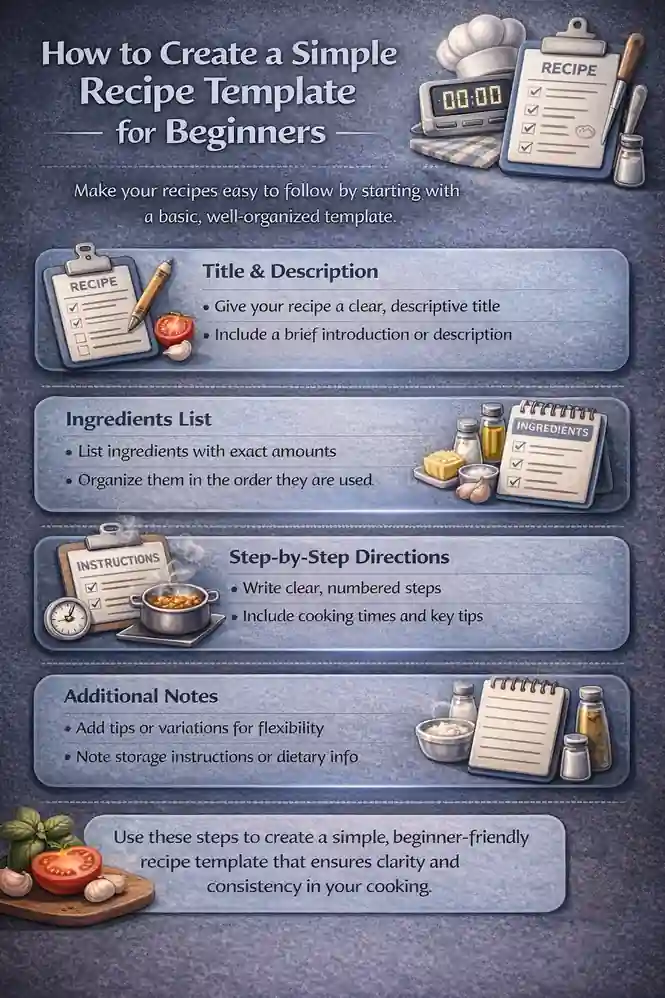
The Core Parts of a Beginner Recipe Template
A beginner-friendly recipe template should include only the essentials.
Start with a recipe title and brief description so you know what you’re making.
List ingredients in the order they are used, with clear measurements.
Write step-by-step instructions, one action per step, using plain language.
Include basic timing, such as prep time and cook time, to set expectations.
Add a short notes section for substitutions or simple tips.
This mirrors how professional kitchens simplify training recipes—clear, direct, and practical.
How to Create Your Template Step by Step
Begin with a blank page or document.
Add headings for Ingredients, Instructions, and Notes.
Write ingredients exactly as they’ll be used, not grouped by category.
Break instructions into short, numbered steps.
Review the recipe once as if you’ve never cooked it before.
If it makes sense to a first-time cook, the template is doing its job.
Keep It Simple as You Learn
A beginner recipe template doesn’t need advanced sections like nutrition data or scaling formulas. Those can come later.
The most effective templates grow with experience. Start simple. Use the same format every time. As your confidence improves, your recipes will too—without changing the structure.
“When we train new cooks, we don’t start with technique—we start with structure. A simple recipe template teaches beginners how to think in sequence: prep first, cook second, finish last. Once that framework is in place, mistakes drop fast and confidence rises. It’s the same approach that works in professional kitchens, just scaled down for learning.”
Essential Resources
01. Simple Editable Recipe Template You Can Start With
https://www.101planners.com/recipe-template/
A clean downloadable template in Word, PDF, or Google Docs that lets you start documenting recipes immediately. It strips format noise so you focus on the how of cooking instead of layout.
02. Ready-to-Use Google Docs Recipe Templates
https://thegoodocs.com/freebies/recipe-templates/
A large library of prebuilt recipe sheets designed for Google Docs. These are great when you want consistent formatting without building a template from scratch.
03. Visually Designed Recipe Layouts for Presentation
https://www.canva.com/templates/s/recipe/
Professionally styled templates with visual appeal. Best for food bloggers, content creators, and anyone who wants their recipe format to look polished and professional.
04. Excel Recipe Templates Built for Real Kitchen Use
https://www.chefs-resources.com/kitchen-forms/recipe-template/recipe-templates-excel/
Excel templates modeled after professional kitchen standards. These allow you to standardize recipes, scale portions, and embed calculations — the same principles chefs rely on for consistency.
05. Full-Page Printable Recipe Templates for Binders
https://www.printablee.com/post_printable-full-page-recipe-templates_359537/
Full-page formats with room for detailed instructions, ingredients, and notes. Useful if you want physical printouts, a recipe binder, or heirloom recipe books.
06. Multi-Format Recipe Templates (Sheets + Docs + Excel)
https://spreadsheetdaddy.com/templates/recipe
Templates available across tools like Google Sheets, Docs, Excel, and PDF. Handy when you need flexibility in how you organize, share, and scale your recipes.
07. Printable Recipe Card Templates for Quick Reference
https://www.neworchards.com/templates/recipe-card
Compact, printable card templates that let you capture recipes in a concise format — perfect for quick kitchen reference, sharing with friends, or gifting.
Supporting Statistics
The data below reflects everyday issues cooks see when recipes lack clear structure—and why templates help control them.
1. Food Safety Relies on Clear Process
48 million Americans get sick from foodborne illness each year.
128,000 hospitalizations and 3,000 deaths occur annually.
In practice, problems often come from:
Missing temperature guidance
Skipped holding times
Unclear prep order
Recipe templates force critical safety details to be written and followed.
Source (CDC.gov):
https://www.cdc.gov/food-safety/data-research/facts-stats/index.html
2. Food Waste Is a Documentation Problem
30–40% of the U.S. food supply is wasted.
That equals 133 billion pounds and $161 billion lost.
Common causes in kitchens:
Poor yield guidance
Inconsistent portioning
No storage or reuse notes
Templates reduce waste by standardizing quantities and handling.
Source (USDA.gov):
https://www.usda.gov/about-food/food-safety/food-loss-and-waste/food-waste-faqs
3. Overproduction Scales Fast Without Structure
72.2 million tons of surplus food were generated in the U.S. in 2023.
Roughly 30% of total production exceeds demand.
Professional kitchens control this through:
Standardized recipes
Portion and yield discipline
The same principles apply at home on a smaller scale.
Source (ReFED.org):
https://insights-engine.refed.org/food-waste-monitor?view=overview&year=2023
4. Waste Is Also an Environmental Issue
30–40% of food in the U.S. is never eaten.
Wasted food is the most common material sent to landfills.
Clear prep, storage, and reuse notes reduce unnecessary discard.
Source (EPA.gov):
https://www.epa.gov/sustainable-management-food/united-states-2030-food-loss-and-waste-reduction-goal
Clear recipe templates turn structure into results by reducing safety risks, cutting food waste, and improving portion control—directly supporting maximizing profit through consistent execution, lower losses, and smarter use of ingredients in both professional and home kitchens.
Final Thought & Opinion
Clear structure is what separates recipes that work from recipes that just look good, and this is especially true for skate fish recipes, where precise steps, timing, and handling determine whether the dish succeeds—experience shows results consistently improve when structure comes first.
Recipe templates function as practical guardrails. In daily use, they help:
Prevent skipped steps
Clarify timing and sequence
Reduce waste and rework
Improve repeatability
A common misconception is that templates restrict creativity. In reality, they create space for it. When the format is handled, attention shifts to what actually matters:
Flavor
Technique
Refinement
Instead of troubleshooting instructions.
The takeaway is simple. Recipe templates aren’t about writing better recipes—they’re about producing better outcomes. Once that structure is in place, cooking becomes more confident, efficient, and reliable.
FAQ on Recipe Template
Q: What does a recipe template really do?
A:
Acts as a cooking workflow.
Organizes steps, timing, and ingredients.
Makes results repeatable.
Q: Why do beginners benefit from recipe templates?
A:
Removes guesswork.
Prevents skipped steps.
Builds confidence through consistency.
Q: What makes a recipe template effective for learning?
A:
Ingredients in prep order.
Short, clear steps.
Basic timing and notes.
Q: Are recipe templates only for professionals?
A:
No.
Chefs and home cooks use the same structure.
Works for beginners and experienced cooks.
Q: Do recipe templates limit creativity?
A:
No.
Structure handles the process.
Creativity focuses on flavor and technique.