We answer more reader questions about basa than any other freshwater fish, so we've spent real time comparing packages from U.S. and European retailers. This is the checklist we use ourselves, and we don't trust a basa package that fails any of it.
TL;DR Quick Answers
basa fish
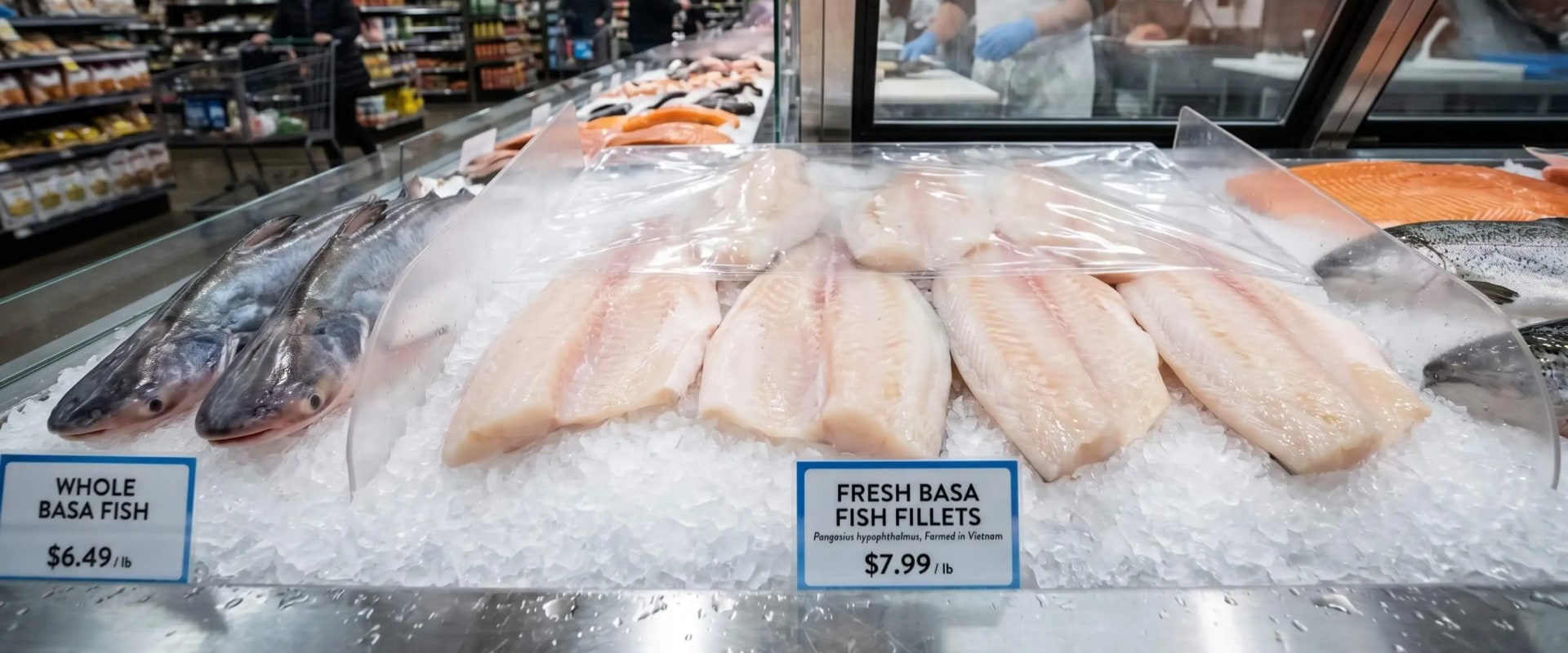
Basa (Pangasius bocourti) is a mild, flaky white freshwater catfish farmed in Vietnam's Mekong Delta and sold worldwide as one of the most affordable white fish on the market.
Key facts:
Species: Pangasius bocourti
Commonly confused with: swai and tra (Pangasius hypophthalmus), closely related but not the same species
Origin: Vietnam produces about 42 percent of global pangasius supply
Farming: always farm-raised; wild basa almost never reaches export markets
Flavor and texture: mild and slightly sweet, with a tender, flaky flake that takes on seasonings well
Sustainability: ASC and multi-star BAP are the two certifications worth trusting
Price: consistently cheaper than cod or haddock
The single most reliable quality signal on a basa package is label transparency. A fillet with the scientific name, a specific Mekong Delta origin, an ASC or BAP logo, and a one-ingredient list almost always tastes better than an uncertified package that saves you a dollar.
Top Takeaways
• The true basa is Pangasius bocourti. If the label says only “pangasius” or “white fish,” you're likely getting the cheaper substitute.
• Vietnam is the source of almost all basa worldwide, and a specific Mekong Delta origin is a green flag.
• Wild-caught basa effectively doesn't exist in export markets. A “wild-caught” claim is a reason to put the package back.
• ASC and multi-star BAP are the two seals worth trusting.
• The number that matters is net weight excluding glaze, not gross weight.
• A clean ingredient list (just basa) beats one padded with sodium tripolyphosphate.
• “Fresh” basa in markets far from Vietnam is almost always previously frozen.
• Use-by is a safety deadline. Best-before is a quality guideline. Don't confuse them.
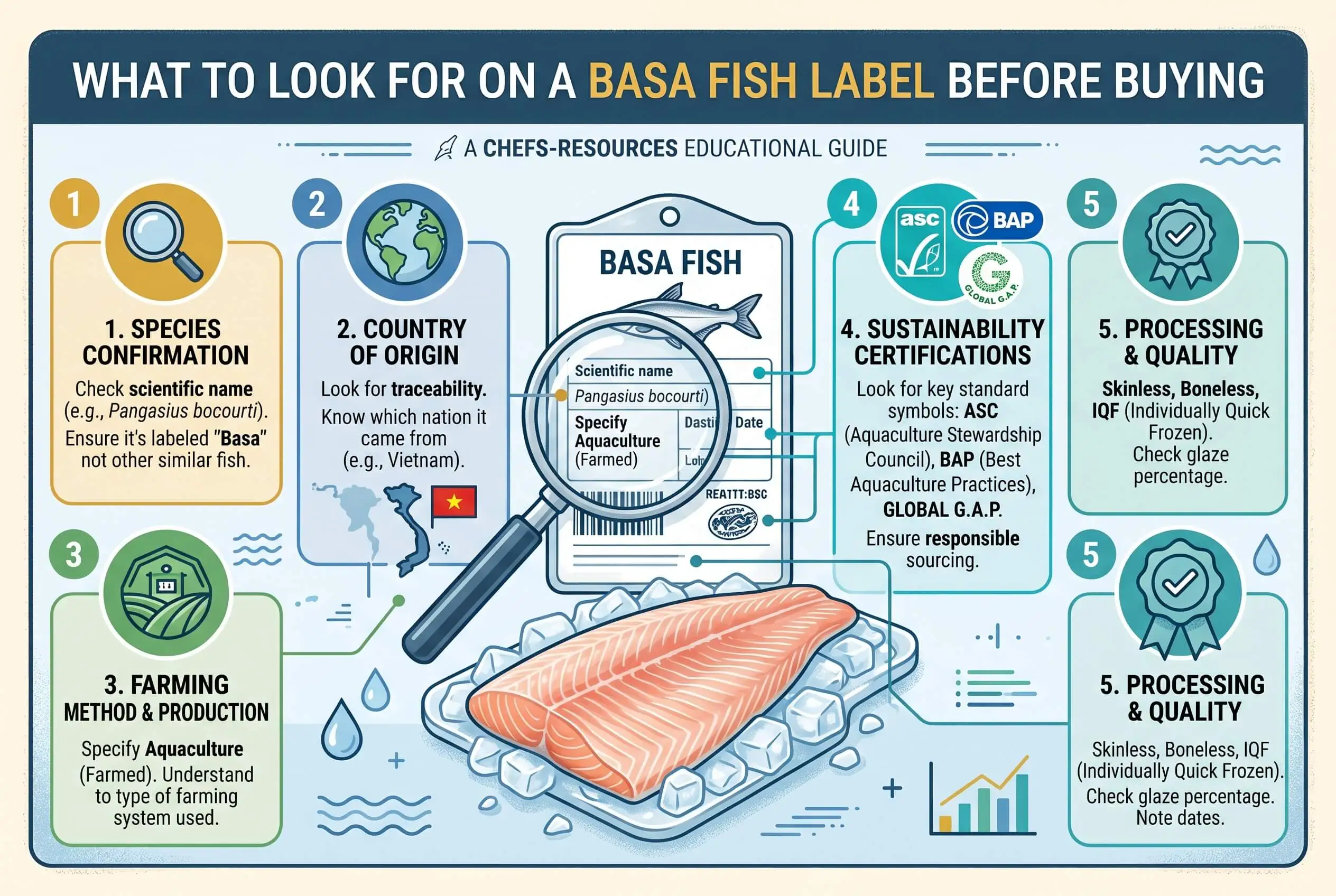
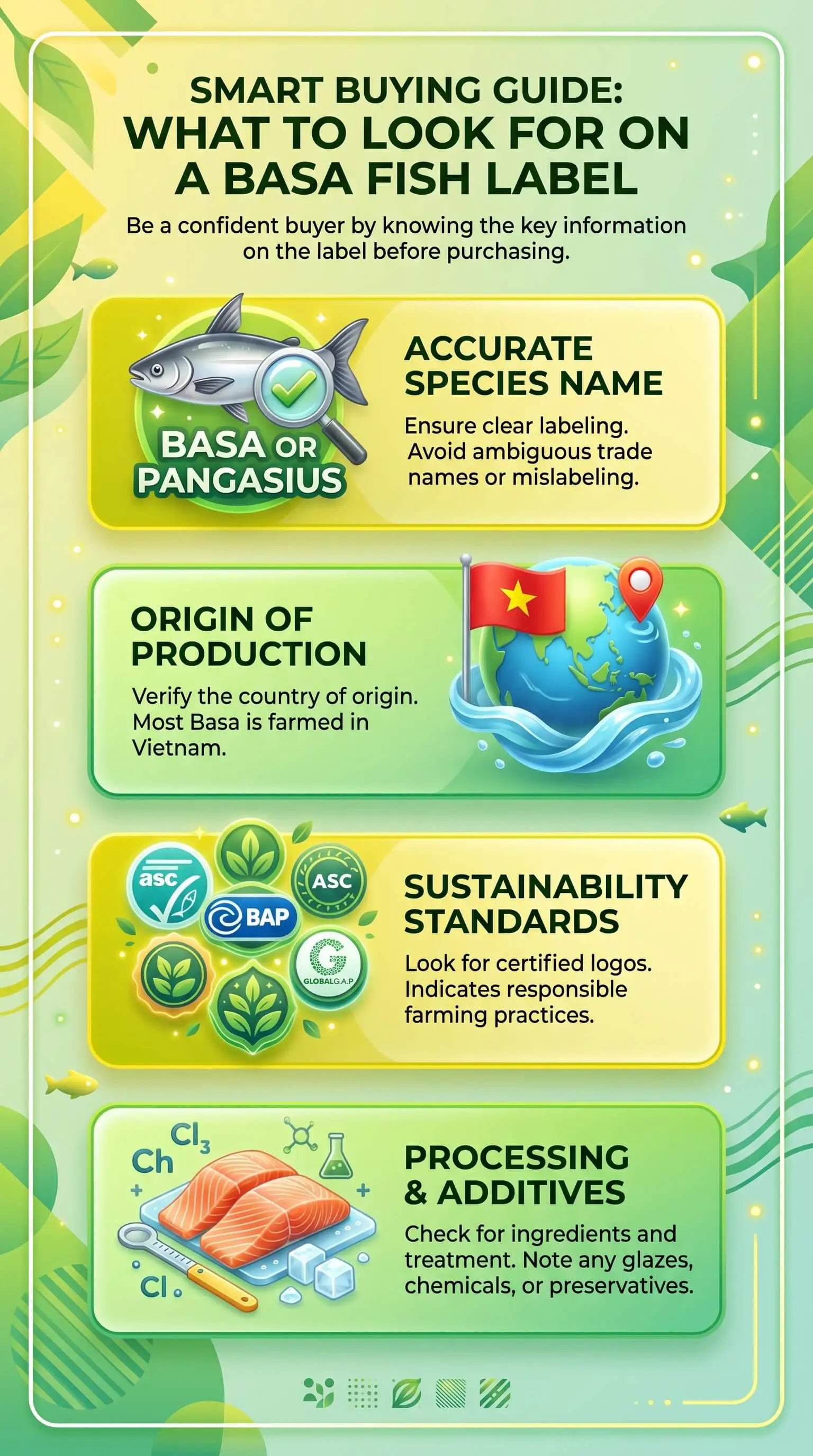
What to Check on a Basa Fish Label: The 8 Essentials
Basa is a freshwater catfish farmed in Vietnam's Mekong Delta, sold cheap, and shipped around the world at volume. That scale is what makes it a weeknight staple. It's also what makes the supply chain long enough for substitutions and vague labeling to creep in. These are the eight things we check every time before a package goes in the cart.
1. The species name
The true basa is Pangasius bocourti. Several closely related species get sold under the same aisle, especially Pangasius hypophthalmus, which you'll see labeled as swai, tra, river cobbler, panga, or just “pangasius.” A package that says only “white fish” or “pangasius” with no Latin name usually holds the cheaper substitute. We check for the scientific name every time, even when it's printed in the smallest text on the back.
2. The country of origin
Vietnam produces most of the basa sold in the U.S. and Europe, and the best packages say so clearly. A label that reads “Product of Vietnam, Mekong Delta” is doing its job. One that reads “imported,” “product of multiple countries,” or skips origin altogether is worth a question at the seafood counter before you buy.
3. Whether it's farm-raised or wild-caught
Basa is a farmed fish, full stop. Wild basa exists in the Mekong, but it almost never reaches export. A “wild-caught basa” claim on a U.S. grocery shelf is a reason to put the package back. The labels we trust go further and name the farming method, whether that's pond-raised or a recirculating system. A producer willing to say how they farm usually farms better.
4. Sustainability certifications
Look for the actual logo, not the phrase “sustainably sourced,” which carries no audit behind it. The two seals worth trusting are ASC (Aquaculture Stewardship Council) and BAP (Best Aquaculture Practices) at two-, three-, or four-star levels. Monterey Bay Aquarium's Seafood Watch program recognizes both as “Good Alternative” sources, which is the best rating currently available for farmed pangasius.
5. Net weight versus glaze weight
Frozen basa is almost always coated in a thin layer of ice, called glaze, to protect it from freezer burn. Some labels list only the gross weight, which includes the ice. The number worth reading is “net weight excluding glaze,” and the cleanest labels disclose the glaze percentage outright, often between 10 and 20 percent. A gross-weight-only label means you'll get roughly 15 to 25 percent less fish than the package implies.
6. The ingredients list
A clean basa fillet lists one ingredient: basa fish, ideally with the scientific name in parentheses. That makes it a strong starting point for any solid recipe template, because you know exactly what you’re working with. Watch for sodium tripolyphosphate, usually shortened to STPP, a moisture-retention additive that pumps up water weight and softens texture. It's not unsafe at the levels food processors use, but it's a sign the producer is padding the package. We buy the additive-free version whenever it's on the shelf.
7. Frozen, previously frozen, or fresh
Most basa sold outside Vietnam is frozen at the processing plant and then either kept frozen for retail or thawed in the case, while skate fish is often valued for its fresh, delicate texture and more specialty appeal at the counter. “Fresh” basa thousands of miles from the Mekong is almost always “previously frozen,” which is fine to buy but means you shouldn't freeze it at home. We cook thawed basa within 24 hours, every time.
8. Use-by, sell-by, and best-before dates
These three terms look similar and mean different things. Sell-by is the retailer's deadline for pulling the product off the shelf. Use-by is your safety deadline as the consumer, and for thawed basa it's non-negotiable. Best-before is only a quality guideline, and it's the one that applies to still-frozen basa sitting in your freezer.
“After a few years of comparing basa packages from major U.S. and European retailers, one pattern holds up almost every time: the producers who disclose the most on the label tend to deliver the best fish. A package that shows the Latin name, names a specific Mekong Delta farming province, lists glaze percentage, prints an ASC or BAP certification number, and keeps the ingredient list to one line almost always delivers a fillet that matches. The vague labels deliver vague fish. Transparency is the single most reliable proxy for quality you can find without a lab, and it costs the producer nothing to be honest. When they aren't, that tells you something too.”
7 Essential Resources
These are the references we keep bookmarked for any basa question that lands in our reader inbox. Every one is a primary source we've used and verified ourselves.
1. FDA Seafood List — Guidance for Industry: the official U.S. database of acceptable market names, including the entry that confirms “basa” is the coined market name for Pangasius bocourti.
2. NOAA Fisheries — Seafood Fraud: a federal overview of how mislabeling happens, what regulators are doing about it, and how to report suspected fraud.
3. Monterey Bay Aquarium Seafood Watch — Sustainable Catfish and Pangasius Guide: the most widely used consumer sustainability rating for farmed pangasius species, including basa.
4. Aquaculture Stewardship Council (ASC) — Pangasius Farming: the certification body's own explainer on pangasius species, farming standards, and what the ASC logo on a label actually verifies.
5. Global Seafood Alliance — BAP-Certified Pangasius: background on the Best Aquaculture Practices star ratings and how BAP-certified pangasius earned a “Good Alternative” rating from Seafood Watch.
6. Wikipedia entry for basa (Pangasius bocourti): a well-cited overview of the species, its biology, naming history, and global trade context, useful for quick orientation.
7. Chefs Resources — a professional buyer's reference for basa fish: a chef-focused specification sheet covering yield, butchering, and culinary applications, with supplier-grade detail beyond what most consumer guides offer.
3 Statistics
Three numbers explain most of what makes basa labels look the way they do.
1. Vietnam accounts for 42 percent of global pangasius production
The figure comes from the Vietnam Department of Fisheries, with India, China, and Bangladesh together accounting for another 15 to 21 percent. A basa label that doesn't name Vietnam or one of those neighbors as its origin is worth a second look. Source: Tridge / Vietnam Ministry of Agriculture and Rural Development.
2. Vietnam's pangasius exports passed $2 billion in 2025
Industry data from VASEP, the Vietnam Association of Seafood Exporters and Producers, shows pangasius is now one of the country's largest seafood export categories, with frozen fillets leading the trade. When a market moves that much product, label discipline is the only thing standing between you and the cheaper substitute. Source: Mekseaconnection / VASEP industry report.
3. One in five U.S. seafood samples has been found mislabeled
Oceana's 2018 testing of more than 400 seafood samples across 24 states found a 21 percent mislabeling rate. Pangasius was one of the species most often substituted for pricier fish like grouper, sole, and cod. Read the label, and when you're unsure, check the species name yourself. Source: Oceana USA seafood fraud investigation.
Final Thoughts and Opinion
Basa gets a lot of unfair criticism. It's a cheap, mild, easy fish to cook when the label is honest, and the industry has genuinely improved in the last decade. From a kitchen management standpoint, that makes basa an even stronger choice: ASC and BAP certifications now cover a real and growing share of Vietnamese production, and the Monterey Bay Aquarium upgraded BAP-certified pangasius to a “Good Alternative” rating after benchmarking the standards against its own criteria.
The entry-level, uncertified basa at the bottom of the freezer aisle is rarely worth the dollar or two you save. A certified package buys you a verified supply chain, less environmental damage, and a fillet that genuinely tastes better. We'd rather buy basa once a week with confidence than three times a week with second-guessing.
Frequently Asked Questions
Is basa fish safe to eat?
Yes, basa is generally safe to eat when it's sourced from a reputable producer and cooked thoroughly. The real quality and safety differences come from farming practices, which is why the ASC and BAP certifications matter on the label. A certified fillet has gone through an audited supply chain. An uncertified one hasn't.
Why is basa fish so cheap?
Basa is cheap because it grows fast in pond aquaculture, needs relatively little feed per kilogram of fish produced, and is farmed at an enormous scale in Vietnam's Mekong Delta. Retail prices sit well below cod or haddock as a result.
What's the difference between basa, swai, and tra?
Basa is Pangasius bocourti. Swai and tra are both market names for Pangasius hypophthalmus, a closely related but genuinely different species. They look and taste similar, but swapping one for the other is mislabeling. FDA labeling guidance distinguishes between them, and sellers who use the names loosely are out of compliance.
Where does most basa fish come from?
Most basa sold globally is farmed in Vietnam, with the biggest concentration of farms in the Mekong Delta provinces of An Giang, Dong Thap, Can Tho, and Vinh Long. India, China, Bangladesh, and Indonesia also produce pangasius species, but Vietnam still leads international export by a wide margin.
How can I tell if my basa is high quality?
Look for a Latin name on the label (Pangasius bocourti), a specific country and region of origin, an ASC or BAP certification logo, a disclosed or low glaze percentage, a single-ingredient list, and a use-by date that gives you several days of runway. The more transparent the label, the better the fish almost always turns out.
Does basa fish have a strong flavor?
No. Basa is one of the milder white fish on the market, with a clean, slightly sweet flavor and a tender, flaky texture. The mildness is why it pairs well with bold seasonings, marinades, and sauces, and why it's often a first-fish pick for kids.
Ready to Shop Smarter?
Save this checklist for your next grocery trip. For a printable version of the 8-point label guide along with our other seafood sourcing resources, click or tap here to subscribe to our newsletter. The full sustainable seafood buyer's pack lands straight in your inbox.
If you've spotted a confusing basa label of your own, drop a photo in the comments below. We read every one and add the trickiest examples to our ongoing label-decoding series.